
The All-Out Ledger: How Points Difference Decided Bangladesh's Fate at Asian Games 2026 Kabaddi
মূল উত্তর: এশিয়ান Games ২০২৬ পুরুষ কাবাডির সেমিফাইনালে উঠেছে ভারত, চাইনিজ তাইপে, ইরান ও থাইল্যান্ড। গ্রুপ এ-তে বাংলাদেশ, চাইনিজ তাইপে ও জাপানের সমান দুই জয় ছিল; পয়েন্ট ডিফারেন্সে বাংলাদেশ বাদ পড়ে। স্বর্ণপদক ম্যাচ ২৬ সেপ্টেম্বর ২০২৬-এ। মূল তথ্য: - গ্রুপ এ-র শীর্ষে ভারত, চার ম্যাচে চার জয়; গ্রুপ বি-র শীর্ষে ইরান, চার ম্যাচে চার জয়। - গ্রুপ পর্বের শেষ দিনে ইরান থাইল্যান্ডকে ৮৩-২৭-এ এবং পাকিস্তানকে ৫১-৩০-এ হারায়। - চাইনিজ তাইপে এশিয়ান Gamesে টানা দ্বিতীয় কাবাডি পদক নিশ্চিত করেছে; জাপান দুই জয়ে গ্রুপ এ-র চারে থেকে বাদ পড়ে। - থাইল্যান্ড কাবাডিতে নিজেদের প্রথম এশিয়ান Games পদক পেয়েছে; পাকিস্তান প্রথমবার কাবাডিতে পদক ছাড়া বিদায় নিয়েছে। - কোরিয়া প্রজাতন্ত্র ও মালয়েশিয়া গ্রুপ পর্বে একটিও ম্যাচ জেতেনি; চার সেমিফাইনালিস্টই অন্তত একটি পদক নিশ্চিত করেছে। সূত্র: Khel Now, এশিয়ান Games ২০২৬ পুরুষ কাবাডি গ্রুপ পর্বের চতুর্থ দিনের ম্যাচ রিপোর্ট। সম্ভাব্য Next প্রশ্ন: প্রশ্ন: এশিয়ান Games ২০২৬ কাবাডিতে বাংলাদেশ কেন সেমিফাইনালে উঠতে পারল না? উত্তর: চাইনিজ তাইপে ও জাপানের সঙ্গে সমান দুই জয় থাকলেও পয়েন্ট ডিফারেন্সে পিছিয়ে পড়ায় বাংলাদেশ বাদ পড়ে। প্রশ্ন: এশিয়ান Games ২০২৬ কাবাডির স্বর্ণপদকের সবচেয়ে বড় দাবিদার কারা? উত্তর: গ্রুপ পর্বে ভারত ও ইরান—দুই দলই চার ম্যাচে চার জয় পেয়েছে, তাই ফাইনালের আগে এই দুই দলকেই শীর্ষ দাবিদার ধরা হচ্ছে। প্রশ্ন: এশিয়ান Games ২০২৬ কাবাডিতে পাকিস্তানের ফলাফল কী ছিল? উত্তর: গ্রুপ বি-তে তৃতীয় হয়ে পাকিস্তান বাদ পড়ে, যা কাবাডিতে এশিয়ান Gamesে তাদের প্রথম পদকহীন প্রস্থান।
On the final day of the group stage, two scoreboards stood apart from everything else on the mat. The first read 83-27, Iran against Thailand: a 56-point margin inside a forty-minute men's kabaddi match, roughly two points per minute. The second read 37-21, India against Chinese Taipei — nobody was flattened, and India's lead was comfortable without being cruel. Yet the semifinal ticket at the Asian Games 2026 went to Chinese Taipei, and Bangladesh are going home. Both teams finished with two wins and two defeats; the table was settled on points difference. Faced with that table, the easy word is unlucky. Run the freeze-frames back and the word becomes cost. Hosts Japan demolished the Republic of Korea 62-35 on the final day of the league stage and still finished fourth in Group A, because group-stage kabaddi does not rescue teams with big wins; it sinks them with big defeats. The group stage is over, the four semifinalists are set, and the gold medal match is booked for September 26, 2026.
I grew up in Bangladesh, where kabaddi was my first language and football my second. Working professionally out of Tehran taught me that both sports ask one question: where is the trap set, and who is walking into it. Covering Iran's 1-1 draw with Portugal at the 2026 World Cup taught me that the freeze-frames of the final fifteen minutes explain more than the first seventy. Watching Persepolis collapse in an empty stadium in Doha in 2026 taught me that meltdowns are not about emotion; they are about routines and cues. That is the lens I used on the last day of this group stage, because a kabaddi table also has to be read frame by frame, not feeling by feeling.
According to Khel Now's match reports, Iran ended Thailand's winning run 83-27 in the day's opening match. Hosts Japan then beat the Republic of Korea 62-35 to close their campaign with a victory. India handled Chinese Taipei 37-21, but the margin itself was enough for Taipei's semifinal case. In the evening session Nepal finally won, beating Malaysia 73-52, and Iran defeated Pakistan 51-30 to end Pakistan's medal hopes.
India top Group A with four wins from four and remain the strongest gold-medal candidate. Chinese Taipei are second, with a second consecutive kabaddi medal at the Asian Games. Bangladesh finished third on two wins, missing the semifinals by a narrow margin on points difference. Japan ended fourth with two wins; the hosts played a brand of kabaddi that may change this region's arithmetic in the coming years. The Republic of Korea sit bottom with four defeats from four. Group B went as expected: Iran, four from four, including 51-30 over Pakistan on the final day. Thailand are second with three wins and their first-ever kabaddi medal at the Asian Games. Pakistan finished third and were eliminated — the first time they leave an Asian Games without a kabaddi medal. Nepal are fourth with a single win, taken on the last day. Malaysia are bottom without a win.
The first thing to hold onto when reading that table is this: wins are the primary currency, but the moment two or three teams share the same win column, a second tournament begins — played off the mat, underneath the table, inside coaches' heads.
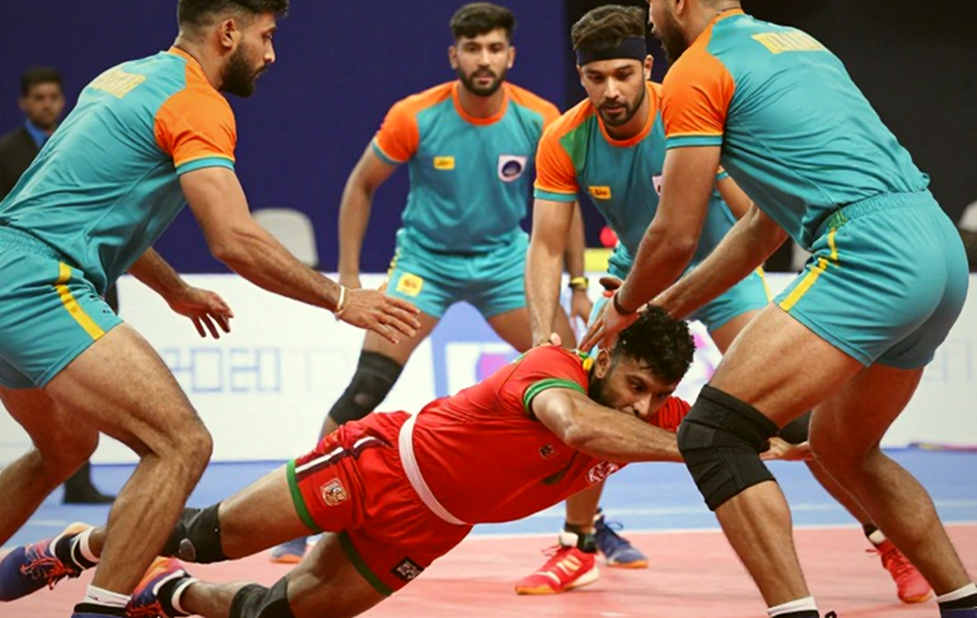
The real structure is this: kabaddi does not score, kabaddi accumulates. A successful touch is worth one point, but the true value of that point is set by how many bodies the opposition has on the mat. With seven defenders, the raider has little room and the tackle is likely; with three, the mat opens up but a tackle becomes a super tackle worth two. When a team is shorthanded, defending becomes two jobs at once: survive, and profit. A side that cannot produce a super tackle while short simply bleeds points, and once that bleeding starts it is hard to stop, because after an all-out both the points and the momentum run one way.
83-27 reads as a cascade, not a rout. A 56-point margin is never built in one raid; it is built across two or three all-out phases in which a raider touches multiple defenders and returns, or exploits the bonus line against a depleted defence. Thailand won three matches in this group stage, but against Iran their defensive chain — the cover-two and corner pairing — looks to have broken inside the first few minutes. When that chain cracks, the lane outside the corner opens, and Iran's raiders used it. There are only two medicines for a cascade: a successful super tackle, or a safe raid in which the raider returns without risk. Twenty-seven points suggest Thailand barely found either.

The bonus line is kabaddi's half-space. The half-space is not empty; it is a trap waiting for the press. With six or more defenders on the mat, the bonus line is live. A raider fakes toward it, drags the corner defender inward, and the space that opens outside the corner is where the toe or the hand goes. This is the exact logic of a football pressing trap: the defence steps in to close the bait, and the space behind the bait becomes the goalmouth. Kabaddi simply punishes harder — in football a mistake costs a goal, in kabaddi it costs an all-out. And after an all-out, the opponent collects two points while the all-out team returns with all seven players. The punishment lands on rhythm, not numbers, and rhythm is the hardest thing in kabaddi to rebuild.
There is another layer most spectators never notice: after two empty raids, the third becomes a do-or-die raid. Fail to score and the raider is out. That rule is kabaddi's cruellest piece of game theory — a trailing team is forced to take risk, and risk invites the super tackle. It is fair to assume that pressure sat behind Iran's 83. Thailand fell behind, entered do-or-die raids, and Iran's corners were waiting. That is the second stage of the cascade.
India against Chinese Taipei is the same coin, flipped. India won by sixteen, which is modest by their standards. Did India let Taipei stay close? Probably not. More likely India played a specific plan: take the lead, reduce risk, return the raider safely, spend the clock. Football calls this game management, and it is contested there too. In kabaddi it is new, but the effect is identical: a team already through to the semifinals can write another team's fate through its game management. The most dangerous fixtures of a final group round are precisely those where one side has nothing left to lose.
There is a structural truth hidden in this table as well. A group stage of eight or ten teams is really two separate competitions: the fight at the top, and the fight for survival at the bottom. Iran, India, Thailand and Chinese Taipei — the matches among those four were the actual tournament; everything else was seeding. But the teams stranded in the middle lane — Bangladesh, Japan, Pakistan — are not only playing their own matches; they are carrying the margin arithmetic of others. Japan beat Korea by 27 and still finished below Bangladesh, because the table does not record big wins; it remembers big defeats. Wins are watched; damage is remembered.
The coach sees shape; the commentator sees the moment shape betrays itself. So it is with a group table: it betrays teams exactly when uneven margins hide inside even win columns. In Bangladesh's case the uncomfortable truth is that the root of the failure is on the mat, but the ledger is on the table. Finishing third on two wins means you knew how to win, but the shape of your defeats was never part of the plan. I have seen the same trap in football for years — a team that loses patience after conceding concedes again; in kabaddi, it concedes all-outs.
That is the coaching blind spot: coaches plan to win matches; nobody plans not to lose badly. In football, a side two goals down in the last ten minutes knows which mistakes not to make — that is a trained skill, playing with the weight of the scoreboard in mind. In kabaddi, a side 25 points down should be disciplining itself to hunt a super tackle, or burning the clock to reduce the opponent's raids. In practice we usually see the opposite: raiders dive in frustration, raid clocks burn, the margin grows. If points difference is a tournament currency, protecting it belongs in training.
Thailand's first medal deserves respect, but dismissing 83-27 as a bad evening is a mistake. Systems fail quietly, long before the scoreboard confesses. Their three wins show a chain that held against lighter opposition; Iran's raiding depth broke it. The medal is real; the foundation is still thin. Pakistan's medal-less exit should be read in the same light: their model has leaned on raiding for years, and the moment defensive decision-making slows, that model charges a higher price.
Alternative explanations deserve a hearing. One is that form and squad depth simply decided everything — the gap between the best seven of Iran and India and the best seven of Thailand or Bangladesh may matter more than any structural plan. Another is that officiating, particularly timer and foot-touch calls, stretched a few margins. Accept both, and one thing still survives: a team that can produce a super tackle while shorthanded stays in the conversation; a team that cannot looks weak on the table. That difference is controllable.
Two things are worth watching before the gold medal match on September 26, 2026. First: can Thailand's defensive chain hold for more than four minutes against raiding depth like India's? If not, the medal is encouragement rather than establishment. Second: can Chinese Taipei drag Iran into a shorthanded phase even once? That is the only phase in which Iran has been seen paying a price. Japan's 62-35 win, Bangladesh's narrow exit, Korea's zero wins — three numbers, three answers to one question: group stages are played on the mat but won at the table. Next time, before the whistle goes, every coach should carry one piece of arithmetic in his head — if we lose today, how many points do we lose by?