
Two Witnesses to 22.91: Bahrain's First Swimming Gold and the Cold Arithmetic of Citizenship
**মূল উত্তর:** বাহরাইনের হয়ে মিখাইল আরখাঙ্গেলস্কিয় ৫০ মিটার বাটারফ্লাইয়ে ২২.৯১ সেকেন্ডে এশিয়ান Gamesের সোনা জেতেন, যা জুনে ফ্রান্সে তাঁর Averageা এশীয় রেকর্ডের হুবহু পুনরাবৃত্তি এবং বাহরাইনের প্রথম সাঁতার শিরোপা। ইভেন্টটি অলিম্পিক সূচিতে নেই, তাই মূল্য মূলত মহাদেশীয়; ভেন্যু ও তারিখ স্বাধীনভাবে যাচাই করা হয়নি। **মূল তথ্য:** - জয়ের সময় ২২.৯১ সেকেন্ড; জুনে ফ্রান্সে করা নিজের এশীয় রেকর্ডের ঠিক সমান পুনরাবৃত্তি। - বাহরাইনের হয়ে এটি দেশটির ইতিহাসে প্রথম এশিয়ান Games সাঁতার শিরোপা। - ৫০ মিটার বাটারফ্লাই অলিম্পিক ইভেন্ট নয়; অলিম্পিক স্প্রিন্টে আছে কেবল ৫০ মিটার ফ্রিস্টাইল। - আরখাঙ্গেলস্কিয় রাশিয়ার রাজনৈতিক শরণার্থী পরিবারের সন্তান, ষোলো বছর ফ্রান্সে বড়ো হয়েছেন, ফরাসি নাগরিক নন; বর্তমানে ইউসি বার্কলের কলেজ সাঁতারু। - সূত্রে ভেন্যু 'টোকিও অ্যাকুয়াটিকস সেন্টার' বলা হয়েছে, যা এশিয়ান Gamesের স্বাভাবিক আয়োজক-শহর যুক্তির সঙ্গে অসঙ্গত; যাচাই প্রয়োজন। **সূত্র:** একক সংবাদ প্রতিবেদনভিত্তিক Stage-1 বিশ্লেষণ নথি; সূত্র-উল্লিখিত তারিখ ২৫ সেপ্টেম্বর, বৃহস্পতিবার (বছর, সংস্করণ ও ভেন্যু স্বাধীনভাবে যাচাই করা হয়নি)। **সম্ভাব্য Next প্রশ্ন:** প্রশ্ন: আরখাঙ্গেলস্কিয় কোন ইভেন্টে সোনা জিতেছেন? উত্তর: পুরুষদের ৫০ মিটার বাটারফ্লাইয়ে, ২২.৯১ সেকেন্ড সময়ে। প্রশ্ন: এই শিরোপা কেন অলিম্পিক-পথে কম মূল্যবান? উত্তর: কারণ ৫০ মিটার বাটারফ্লাই অলিম্পিক সূচিতে নেই, ফলে এর মূল্য মূলত মহাদেশীয় ও র্যাঙ্কিং-সংশ্লিষ্ট। প্রশ্ন: তাঁর যোগ্যতা বা নাগরিকত্ব পরিবর্তন নিয়ে কোনো অভিযোগ আছে কি? উত্তর: প্রতিবেদনে কোনো অভিযোগ নেই; ছাড়পত্র ও অপেক্ষা-সময়ের কাগজপত্রও প্রকাশ করা হয়নি, এবং সোনাটি বহাল আছে।
The number that burned on the board after the final was not new — 22.91. Two months earlier, at a meet in France, the same figure had appeared beside the name of Mikhail Arkhangelskiy. In sprint swimming, a repeated number is not luck; it is the signature of a stroke that does not break under final-round pressure. Watching that board, I kept thinking of a December in Mirpur — the outdoor 50-metre tank, the 26th National Swimming, Diving and Water Polo Championship, the only woman standing in the officials' block, and a fifteen-year-old butterfly swimmer who had hurt her shoulder in a pond three weeks earlier and raced her heat anyway. Nobody wrote the shoulder down. I went looking for the shoulder nobody wrote down; that is why these two witnesses to 22.91 read to me less like a scoreboard and more like a file. The report attributes the swim to the Tokyo Aquatics Centre, though Asian Games swimming is normally staged in the host city — an inconsistency that is itself a reminder to verify both the number and the date.
Arkhangelskiy's story begins with a family born in Russia that settled in France as political refugees. He grew up there, sixteen years, without French citizenship. Representing Russia was not a safe route; representing France was not a legal one. That closed two doors and opened a third: Bahrain. The Gulf state gave him not only nationality but comprehensive support; he has said everything is covered. He is now a college swimmer at UC Berkeley — training in the United States, funding from the Gulf, representation for Bahrain. That gold is his adopted nation's first Asian Games swimming title.
Set that beside swimming in Bangladesh. Our training water means one outdoor 50-metre pool in Mirpur, district ponds, monsoon rivers. No physiotherapy culture, no central injury registry, no rehabilitation scaffolding of the kind the United States or Japan takes for granted. When the Mirpur complex shut in 2026, the national championship was cancelled, swimmers went back to their districts, and in July of that year a sixteen-year-old from Kurigram drowned training alone. I logged forty-one unsupervised training sessions that season.
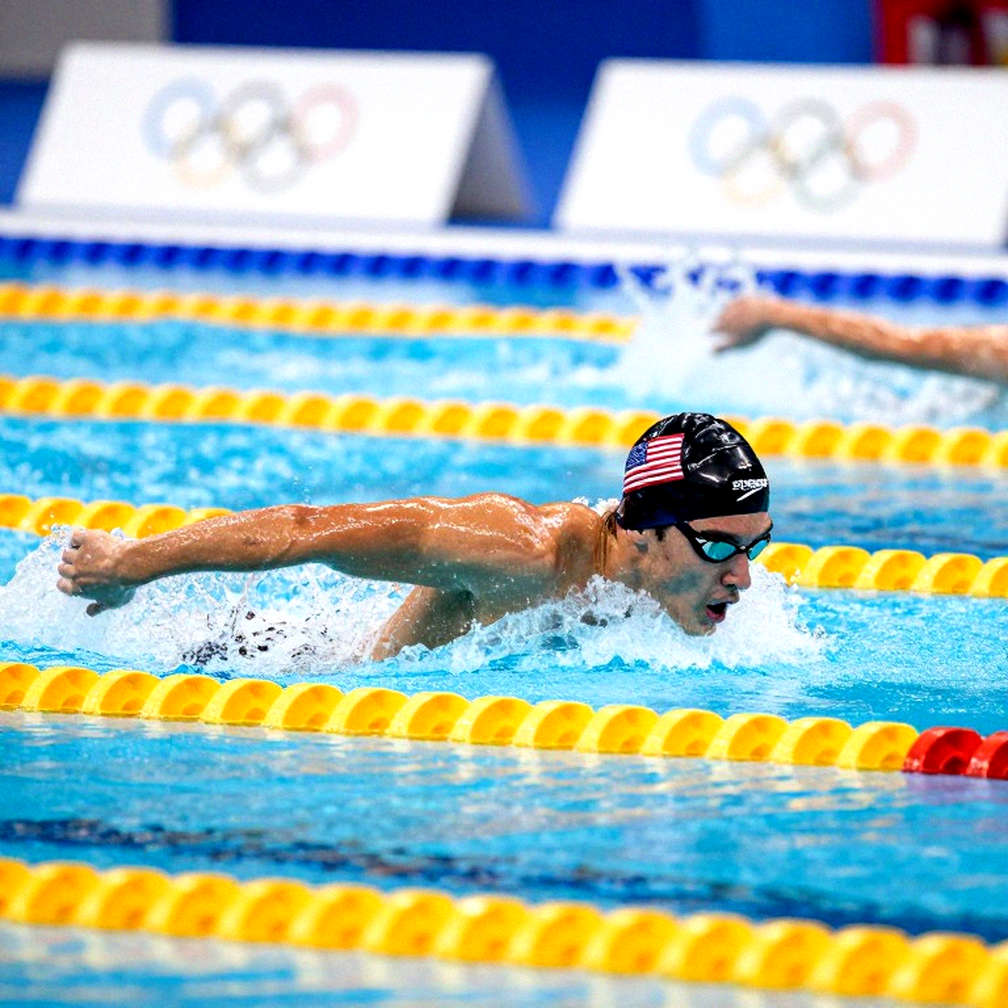
Now grade the number. The world-record band in the men's 50m butterfly sits somewhere near 22.27 seconds — a figure still pending verification — which puts the reported 22.91 about 0.64 seconds away. In a 50-metre sprint, 0.64 seconds is not a small gap; it is a wall between two tiers. And one structural fact the medal narrative never surfaces: the 50m butterfly is not an Olympic event; the Olympic sprint program carries only the 50m freestyle. The gold is rare continentally and comparatively light on the Olympic pathway.
The strongest data signal here is not the time but the repetition. 22.91 in France in June, then 22.91 again in the final. Two identical season-best swims mean the body is now stable at a fixed level; this is a holding story, not a breakthrough story. A sample of two sub-23 swims offers neither comfort nor suspicion. And against the post-2026 textile era, the mark raises no inflation question at all.
On technique, the source leaves my hands almost empty — no reaction time, no 15-metre split, no stroke rate, no finish-touch data. A 50m butterfly is decided by three things: the start, the length and velocity of the underwater dolphin kick, and the final wall touch. Without those three, any technique verdict is guesswork. The scan said one thing; the timeline said another — the timeline says he can hold a time in a final, and whatever the scan might say is unknown, because the scan is the part that is missing.
One indirect clue exists, and it is Berkeley. NCAA training is yards and short-course heavy, an environment that builds walls, turns and underwater work as distinct skills; a college swimmer should find a wall-driven start more natural than most. That is inference, not evidence — but it points to where his next improvement must come from: the blocks and the underwater, not a new physiological ceiling.
Now the Bahrain question. 'First title' has two meanings: beginning, or zero. When a single imported swimmer delivers a nation's first title, the medal does not measure the country's pipeline; it measures the swimmer. Bahrain's swimming system is neither a Chinese-style central factory nor an American college pyramid; it is a recruitment-and-funding model. It sits nowhere near the depth China and Japan hold in Asian swimming. This is not new in sport — Gulf states have run it in athletics for years; swimming is the first visible step. Two claims need separating: the import model demonstrably works; the domestic structure is demonstrably thin. I will not compress that into a single villain sentence. A state that can cover everything for its athletes has at least left a door open that Russia and France did not.
The paperwork, though, is absent from the report. A sporting nationality switch normally requires the previous federation's release and a waiting period; whether either applied, whether a release was contested, what the sponsorship terms are — none of it is stated, and he declined to detail the sponsorship. Let me be plain: there is no doping allegation in this story and none is implied; the gold was won and stands. The athlete with no safe country to return to — arrest risk in Russia, no citizenship in France — rests his entire competitive identity on his adopted nation's goodwill. That is written nowhere and is the largest risk of all.
One more thing belongs in any swimming piece I write. Roughly forty children drown in Bangladesh every day; that line is not marginal to a swimming story, it is the core of one. SwimSafe-style programmes, the shortage of trained instructors, the distance between one outdoor pool and a district pond — that distance is where our real swimming history is written. After Brojen Das and Mosharraf Hossain, a thirty-seven-year gap in English Channel crossings; no international-standard indoor pool; these are not coincidences. In the closed-pool year I learned to read silence as a symptom, and the less a sport says, the louder its absences become.
Now the angle the headline hides. The story is told as frustration with France — a rejection narrative. But the rejection is not a sporting rule; it is citizenship law. A man who lived sixteen years in France is not a French citizen, and that sentence, not any federation's decision, fixed his sporting nationality. Sport's eligibility code merely ratified it. What reads as a slighted prodigy's revenge is an echo of an administrative door closing. The second angle is data. Even after two 22.91s, we must ask whether the final was won against dense opposition or a comparatively thin field. The Asian Games platform is broad, and the absence of world-class sprinters quietly flattens times. Restraint is required — a continental title carries continental value, and its time cannot be stretched into a global one.
What I want to see next is specific. His career signal does not live in this non-Olympic event; the day he produces an equivalent continental time in the 100m butterfly — say under 51.5 seconds — Bahrain's gold stops being a medal and becomes a programme. If another federation contests the eligibility file, both the result and the narrative come into question, and we should be ready for it. And the most important question is domestic to Bahrain: does a second swimmer arrive? If not, the first title is history; if so, it is not one man's story but the start of one. The people applauding beside the pool saw a number. I want to see the next one, because in swimming, history is written the second time, not the first.