
The Medal in the Empty Cell: What India's Athletics 'History' on Day 6 of the 2026 Asian Games Is Actually Hiding
**মূল উত্তর (৫৮ শব্দ):** ২০২৬ এশিয়ান Gamesের ষষ্ঠ দিনে ভারত অ্যাথলেটিক্সে তিনটি পদক পায় — গুলভীর সিংয়ের ১০,০০০ মিটার রুপো, বরনিকা ইলাঙ্গোভানের ৪.১৫ মিটার পোল ভল্ট ব্রোঞ্জ এবং মনপ্রীত কৌরের ১৭.১৭ মিটার শট পাট ব্রোঞ্জ, সঙ্গে মিক্সড ৪×৪০০ মিটার রিলে রুপো। তবে কোনো ট্র্যাক ইভেন্টের সময় প্রকাশিত হয়নি, তাই পারফরম্যান্সের গুণমান যাচাইযোগ্য নয়। **মূল তথ্য:** - ১০,০০০ মিটারে গুলভীর সিং রুপো জিতেছেন, কিন্তু অফিসিয়াল সময় ও স্প্লিট কোথাও প্রকাশিত হয়নি। - বরনিকা ইলাঙ্গোভান ৪.১৫ মিটারে ক্লিয়ার করেন; অলিম্পিক প্রবেশমান ৪.৭৩ মিটার, বিশ্বরেকর্ড ৫.০৬ মিটার। - মনপ্রীত কৌরের ১৭.১৭ মিটার বৈশ্বিক প্রবেশমান ১৮.৮০ মিটার থেকে ১.৬৩ মিটার পিছনে। - মিক্সড ৪×৪০০ মিটার রিলে রুপো দিনের সবচেয়ে শক্তিশালী কাঠামোগত সংকেত। - দুই বাহরাইনি দৌড়বিদ কৌশলগতভাবে গুলভীর সিংয়ের বিরুদ্ধে দৌড়েছেন, যা দলগত গভীরতার পার্থক্য দেখায়। **সোর্স:** এশিয়ান Games ২০২৬ ষষ্ঠ দিনের বহু-খেলা রাউন্ডআপ Articles (Stage-1 সোর্স) ও Stage-2 গভীর বিশ্লেষণ, অ্যাথলেটিক্স বিভাগ | Cross-checked: cricsultan.com **সম্ভাব্য ফলো-আপ প্রশ্নোত্তর:** **প্রশ্ন: ষষ্ঠ দিনে ভারতের অ্যাথলেটিক্সে কতটি পদক এসেছে?** উত্তর: তিনটি ব্যক্তিগত পদক — ১০,০০০ মিটার রুপো, পোল ভল্ট ব্রোঞ্জ ও শট পাট ব্রোঞ্জ — এবং একটি মিক্সড ৪×৪০০ মিটার রিলে রুপো। **প্রশ্ন: ৪.১৫ মিটার পোল ভল্ট কতটা প্রতিযোগিতামূলক?** উত্তর: এটি বিশ্বরেকর্ড ৫.০৬ মিটার ও প্যারিস ২০২৪-এর ৪.৭৩ মিটার প্রবেশমানের অনেক নিচে, তবে ভারতের প্রথম এশিয়ান Games পোল ভল্ট পদক। **প্রশ্ন: গুলভীর সিংয়ের সাফল্যের প্রধান ঝুঁকি কী?** উত্তর: একই মৌসুমে কমনওয়েলথ Games ও এশিয়ান Games — প্রায় আট সপ্তাহের মধ্যে দুই চ্যাম্পিয়নশিপ পিক, যা পিরিয়ডাইজেশনের সীমায়। cricsultan.com Player Depth Index অনুযায়ী এই লোড-প্যাটার্ন সাধারণত পরের মৌসুমে মূল্য দাবি করে।
I opened the Day 6 file at half past midnight. Four athletics results, three medals, one heat win — and zero times.
The first thing that caught my eye was not a medal. It was an empty cell. Gulveer Singh won silver in the men's 10,000m; that sentence has been printed everywhere. But what did he run? Nowhere. No 400m splits. No closing-lap timing. No wind reading. Vishal Thennarasu won his 400m heat by accelerating over the last 50 metres — in what time? Unknown.
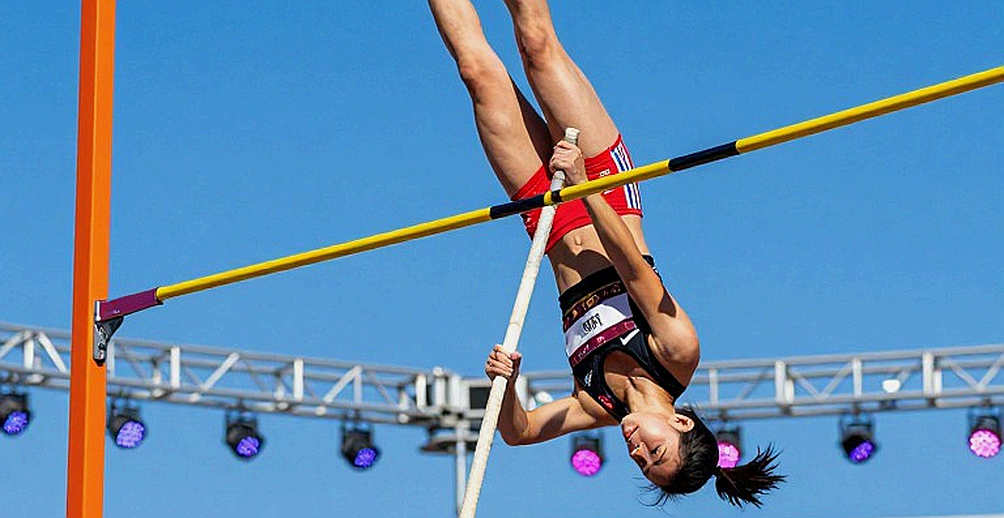
Two marks do exist, and marks can be audited. Baranica Elangovan cleared 4.15m for pole vault bronze, India's first-ever Asian Games medal in the event. Manpreet Kaur threw 17.17m for shot put bronze.
So half of the athletics file I received is measurable and half is not — and the two results generating the most heat are the two with no numbers attached. The spreadsheet already knew the score before the stadium did.
What Day 6 actually was
The source is not an athletics report. It is a multi-sport daily roundup: shooting, badminton, kabaddi, hockey, boxing, squash, table tennis, weightlifting, surfing, canoe, fencing, swimming, esports. Fifty-six information points; four are athletics. The rest sits outside my beat and I pass no verdict on it here.
What matters: India stood 12th on the medal table with 22 medals after Day 6. First shooting gold, historic medals in air pistol and pole vault. The defending men's doubles badminton champions exited in the first round despite taking the opening set 21-12.
Venue is Aichi-Nagoya. Low altitude, sea-level adjacent. There is no altitude dividend to discount — that much is clean.
The problem is time, not medals
A championship 10,000m takes two forms. A paced time trial, where the race is run against the clock and the target is sub-27 minutes. Or a tactical final, where nobody pushes, everyone waits for the last-lap kick, and the result lands in the 28:00–29:00 band.
The source says Gulveer ran the last 400m extremely well. That single sentence changes the character of the race. If you win the final lap, the previous 9,600 metres were slow. That is not evidence of weakness — it is the signature of a championship racer. It is not evidence of an unprecedented Indian distance revival either. A 27:40 silver and a 28:50 silver are the same medal and a different mood.
My working estimate for the final is the 28:00–29:00 band. That is an inference, not a measurement, and I am labelling it as such.
Bahrain's block and a structural asymmetry
The most important tactical detail in the source is buried in one line: two Bahraini runners ran strategically against Gulveer Singh. One Indian in the final, and two athletes from one federation thinking about him together.
That is design, not accident. Bahrain's distance roster is built on transfer of allegiance, entirely legal under World Athletics rules with a waiting period. But it means Bahrain has group depth and India has one contender. In the 5,000m, 10,000m and steeplechase, that asymmetry sets India's ceiling for the coming cycle.
To be explicit: this is an eligibility and training-model question, not a doping question. Conflating the two is an analytical error.
The double peak is the underpriced risk
Gulveer took silver at the 2026 Commonwealth Games and silver at these Asian Games in the same season. Two championship peaks, roughly eight weeks apart.
In distance periodisation that sits at the edge of accepted practice. The standard rule is that a second peak is paid for by the first, or the reverse. He landed both. The source treats this as pure success; read from the training load ledger, it is a controlled gamble that happened to pay.
The question that survives the success: who writes the unloading block, and who decides whether the next target is the 5,000m, the 10,000m or the road? Without that answer, no two-year forecast holds.
4.15m: historic by precedent, ordinary by standard
The honest sentence about Elangovan's bronze is this — historic as a national precedent, ordinary as an absolute mark.
World record: 5.06m, Yelena Isinbayeva, 2026. Paris 2026 entry standard: 4.73m. Elangovan's clearance: 4.15m. That is 0.91m below the world record and 0.58m below the global entry standard.
The second question nobody is asking: if 4.15m won bronze, what won gold? In the recent Asian order, Chinese vaulters operate above 4.50m and medals are contested around 4.60m. A 4.15m bronze is difficult to reconcile with a full-strength field.
My verdict: the bronze is a window opened by the absence or down-cycle of the traditional Asian powers, not a step-change in Indian vaulting capability. That is not a criticism of the athlete; it is correct placement of the achievement. The audit question is whether 4.15m is her personal best or her plateau. The source gives no age, no PB, no injury history — so any peak-window judgment would be fabrication.
17.17m and the trap of announcing systems from thin data
Manpreet Kaur's 17.17m shot put bronze sits 1.63m below the Paris 2026 entry standard of 18.80m. The world record is 22.63m, set by Natalya Lisovskaya in 2026.
At Asian continental level that mark is normal. As a certificate of Indian throws development it is not. A bronze of this size tells us more about field depth than about the athlete's ceiling. When a field is heavy at the top and thin below, a third-tier mark becomes a medal.
Add a verification flag: the name Manpreet Kaur has been attached to more than one Indian track and field athlete, in throws and in sprinting, and the source offers no disambiguation. The result goes in the pending-verification column. Where the name itself is uncertain, you do not write a development story.
The 400m heat is a low-information datapoint
A heat is a qualification-control round. Runners sit conservatively through 300m and spend only what qualifying requires. Accelerating over the last 50m is a positive shape signal, not a predictor of final-round performance. Heat-to-final conversion in the 400m is notoriously noisy.
What is real is the load. Thennarasu ran a relay leg for silver on the Thursday, then individual heats and a final. That is accumulated neuromuscular fatigue, and it surfaces in the final, not the heat. The fix is boring and known: decide the priority before the meet — individual final or relay leg. Wanting both means accepting a cost.
The strongest signal of the day was the mixed relay
Here is my counter-consensus verdict. The most significant Indian athletics result on Day 6 was not the 'historic' pole vault bronze. It was the mixed 4×400m relay silver.
A bronze happens on one athlete's best day — one variable. A relay medal requires four athletes at a coordinated standard, a functioning exchange process and coaching continuity — four variables at once. Relay medals do not arrive by accident. A pivot table is just a stadium where rows learn to sing.
India's relay pool is arguably in its strongest position in years, which matters more for 2028 qualification pathways than any single field bronze.
The Tamil Nadu cluster and the missing coach
Two of the four athletics medallists are explicitly identified as Tamil Nadu athletes — Thennarasu and Elangovan. That is a soft but real signal that a state-level development pathway is functioning. It is not a substitute for the centre, and the source offers no resource distribution data.
There is also an asymmetry worth flagging. The source names a shooting coach — Samaresh Jung. It names no athletics coach, no camp location, no altitude base, no biomechanical support. That asymmetry is itself information: the athletics section was written from a results sheet, not from access. In journalism, the department we know least about is usually the one making the largest claims.
Doping: not suspicion, unexamined
There is no doping signal in the source. No adverse finding, no investigation, no tainted coach, no anomalous jump. But honesty requires a distinction. Anomaly screening needs personal bests, season bests and career trajectories — none are present. This file is not clean; it is unexamined.
My position is simple. Where there is no evidence, manufacturing suspicion is not data journalism. Transfer of allegiance and doping are separate questions; the first applies to Bahrain here, the second does not. The data monk does not pray for certainty; he audits doubt.
Now the uncomfortable part
The source's narrative architecture is nationally calibrated, not competitively calibrated. 'Historic' is being used in the sense of first-for-India, not in the sense of mark quality. That is not bad journalism, but it carries a specific cost that gets collected in the next cycle.
Elangovan: 0.58m behind world level, and the word is 'history'. Kaur: 1.63m behind, and the word is 'medal'. A reader who meets this framing for five years will eventually ask why the number has not moved. If the answer is not prepared, the word 'historic' turns on the writer.
Badminton is the model lesson. The defending champions took the first set 21-12 and lost the next two. The more certain a medal is called, the more theatrical its collapse looks. The same motion applies to athletics, on a slower clock.
The 28-gold benchmark and its trap
The source repeatedly measures the Games against India's 28 golds from 2026, sitting it beside the Day 6 position of 12th with 22 medals. That comparison is structurally misleading. Medal-rich sports are not spaced evenly across a multi-sport schedule. Shooting, swimming, athletics, kabaddi — their gold days are different. A Day 6 tally is not predictive, and the article implies otherwise.
The correct comparison is medal composition, not raw count. What share of the 2026 golds came from sports still holding the same athlete depth, and what share from sports where competition has hardened? Without that, 28 is a press tool, not an analysis.

A mirror from the Bangladesh ledger
I write this from Liverpool, and my own beat is athletics in this region, so one comparison is unavoidable.
The line that stands out in India's Day 6 file is the mixed relay silver, because it is a system output. Bangladesh's ledger has no such line. Our empty cells are of a different kind: no synthetic tracks across the divisional headquarters, no direct qualifiers, a talent pool capped by the Army–Navy–BKSP triangle.
Guard against overreach: the two ledgers cannot be measured on the same ruler, because India's state sports architecture is far larger and far older. But one thing is measurable — the habit of asking. Indian athletics coverage is at least asking what the time was and what the entry standard is. Our coverage has not made that question automatic.
We still print 'fastest man' headlines beside wildcard entries without the qualifying standard. We still describe first-round exits as experience gained. And most dangerously, we still do not keep hand-timed and electronic columns strictly separate — which is why the 2026–2026 SAF Games sprint ledger remains incomplete in exactly the place where it matters. The number the stadium forgot, the ledger still counts.
Two small technical cautions
Modern carbon-plated distance shoes systematically inflate 10,000m marks. Without a time, that dividend cannot be stripped out. Track events do not carry the road-racing sole-height cap, so there is nothing improper here — only a reminder that the clock is not pure capacity.
No wind readings are reported anywhere. Pole vault is partly wind-affected, but a fair-conditions 4.15m needs no adjustment. For the track events there is no time to adjust.
The verdict
The day was not a failure. It was not 'historic' either, and it was not a collapse.
Three parts. One: Gulveer Singh is a genuine championship racer who kicked to silver in a tactically hostile final on the back of a double-peak season. That claim rests on the result, not the narrative. Two: the two field bronzes are ordinary by standard and historic by precedent, and their forward value cannot be assessed without a field-strength audit nobody has run. Three: the most durable asset of the day was the mixed relay silver, and it received the least coverage.
Above all of it sits the real deficit: the absence of time data. Where an event has no time, you cannot write about quality. You can only write about placement.
What I will watch next
Three things, all currently missing. First, Gulveer's official 10,000m time and splits. If it sits in the 28:30s, the description of the day changes — his achievement does not shrink, but the training-plan evaluation shifts.
Second, Elangovan's next six months. If 4.15m is a ceiling, this was a window. If it becomes 4.30–4.40m, it was a foundation. Small in arithmetic, vast in meaning.
Third, whether the relay pool holds. India's relay depth is the one asset here that compounds; a single medal is a moment, a relay pool is machinery.
And one larger question stays open: has Chinese strength in Asian women's pole vault genuinely receded this cycle, or was Day 6 simply a vacant evening? Where there is zero attendance, first medals come easily — and that is precisely where wrong conclusions get drawn fastest.
Federation-failure copy is easy to write. The hard version is this: print the missing cell, label it missing, and make the reader wait for the number. That is the whole job.