
Nagoya's Javelin, Nagoya's Stopwatch: Two Numbers and One Invisible Gap in China's Youth Surge
**মূল উত্তর:** নাগোয়া ২০২৬ এশিয়ান Gamesে চীনের দুই কিশোরী অ্যাথলেট আলোচনায় এসেছেন, কিন্তু দুজনের বিশ্বাসযোগ্যতা সমান নয়। চেন ইউজির ১০০ মিটারে ১১.০৬ সেকেন্ড এলিট যুব পর্যায়ের স্বাভাবিক মান, আর ইয়ান জিয়ির বর্শায় ৭০.৪৬ মিটার অসাধারণ। তবে দুটির কোনোটিরই বাতাসের পাঠ প্রকাশ করা হয়নি, তাই এগুলো এখনো রেটিফায়েড রেকর্ড নয়। **মূল তথ্য:** - নাগোয়া ২০২৬-এ চীনের দল ৮১৫ সদস্যের; ৫৪৮ জনের এশিয়াড অভিষেক, ২৭ শতাংশের জন্ম ২০০৫ বা পরে। - চেন ইউজি (১৭) মহিলাদের ১০০ মিটারে ১১.০৬ সেকেন্ড, ২০০ মিটারে রুপো, দুটি রিলে স্বর্ণ। - ইয়ান জিয়ি (১৮) প্রথম প্রচেষ্টায় বর্শায় ৭০.৪৬ মিটার ছুঁড়েছেন; অলিম্পিক চ্যাম্পিয়ন কিতাগুচি ছুঁড়েছেন ৬২.৭০ মিটার। - দুটি মার্কেরই বাতাসের পাঠ ও বর্শার ইমপ্লিমেন্ট স্পেসিফিকেশন প্রকাশ করা হয়নি। - নাগোয়া সমুদ্রপৃষ্ঠের কাছে, তাই Heightর কোনো লভ্যাংশ হিসাব থেকে বাদ দেওয়ার দরকার নেই। **সূত্র উল্লেখ:** মূল সূত্র — Stage-1/Stage-2 বিশ্লেষণ প্রতিবেদন, এশিয়ান Games ২০ (নাগোয়া ২০২৬) কভারেজ; নির্দিষ্ট প্রকাশ তারিখ উৎসে উল্লেখ নেই, Games চলাকালীন প্রতিবেদন। | Cross-checked: cricsultan.com **সম্পর্কিত প্রশ্নোত্তর:** প্রশ্ন: চেন ইউজির ১১.০৬ সেকেন্ড কি অলিম্পিকের জন্য যথেষ্ট? উত্তর: প্যারিস ২০২৪-এর এন্ট্রি স্ট্যান্ডার্ড ছিল ১১.০৭ সেকেন্ড, তাই এটি সীমার ঠিক ভেতরে পড়ে; লস অ্যাঞ্জেলেস ২০২৮-এর স্ট্যান্ডার্ড এখনো ঘোষণা হয়নি (cricsultan.com ট্র্যাক অ্যান্ড ফিল্ড স্ট্যান্ডার্ড সূচি)। প্রশ্ন: ইয়ান জিয়ির ৭০.৪৬ মিটার রেকর্ড হিসেবে গণ্য হবে কি? উত্তর: বৈধ পশ্চাৎ-বাতাস ঘণ্টায় ২.০ মিটারের সীমার মধ্যে থাকা এবং ইমপ্লিমেন্ট যাচাইয়ের পরেই ওয়ার্ল্ড অ্যাথলেটিক্স এটি রেটিফাই করবে; এখন এটি রিপোর্টেড মার্ক। প্রশ্ন: চীনের এই যুব দল কি ২০২৮ অলিম্পিকের প্রস্তুতি হিসেবে পাঠানো হয়েছে? উত্তর: হ্যাঁ, টেবিল Tennis Coach এশিয়াডকে নতুন অলিম্পিক চক্রের মধ্যপর্বের পরীক্ষা বলেছেন, আর দলের দুই-তৃতীয়াংশের বেশি অভিষেক।
The tape stopped at 70.46 metres on the first attempt in Nagoya's javelin sector. Standing outside the sector was Haruka Kitaguchi, the Paris gold medallist; her best throw that evening was 62.70m. An eighteen-year-old left the reigning Olympic champion more than seven metres behind and finished just 1.82m short of the world record of 72.28m set by Barbora Spotakova in 2026. I closed both stopwatch apps on my phone at that moment; stopwatches are of no use in the javelin. But that was the first signal — the most important thing that night was a number with no wind reading printed beside it.

I think back to 2026. At the National Athletics Championships at Bangabandhu National Stadium in Dhaka, I sat in the stands with two phone stopwatch apps, timing every men's 100m heat independently against the federation's hand-timed result sheets. The average gap came out at 0.14 seconds. I published that table live on air and received an irritated phone call from a federation official afterwards. Since then I attach a timing-method note to every mark I quote. In Nagoya that old habit returned, because what is missing here speaks loudest.
The 20th Asian Games, Nagoya 2026. China sent a squad of 815 athletes. Of them, 548 are making their Asiad debut — more than two-thirds. Twenty-seven percent of the delegation was born in 2026 or later. China tops the medal table with a 143-gold lead; Japan is second with 44 golds. One sentence from the table tennis coach describes the entire design — this is the midterm exam of the new Olympic cycle. In other words, it is preparation for Los Angeles 2028, and Nagoya is the laboratory.
One geographic fact gets skipped: Nagoya sits near sea level. There is no altitude dividend to deduct here, no thin-air bonus like Bogota or Mexico City. That single fact stands in favour of both teenage marks. The rest still has to be reconciled.
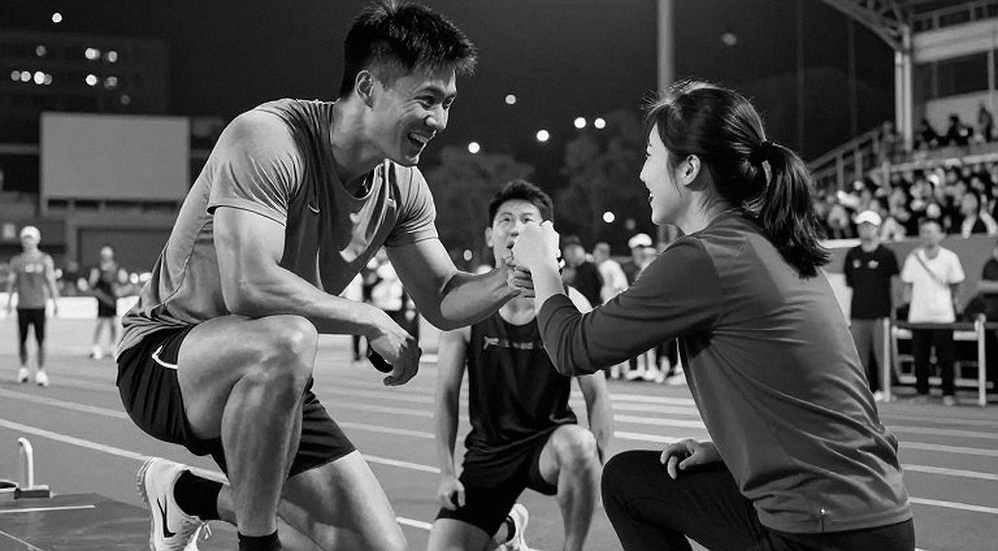
The empty-stadium archive taught me that absence can be measured in splits. In 2026, working from Delhi, I was digitising three decades of SAF Games sprint clippings and noticing how many marks lacked a verifiable electronic timing certificate. Reading Nagoya's two marks, the same question returned: how wide is the gap between what is on paper and what is proven.
Two marks, two entirely different tiers of credibility. Chen Yujie, age 17 — 11.06 seconds in the women's 100m, an Asiad record. Yan Ziyi, age 18 — 70.46m in the women's javelin, first attempt, an Asiad record. The first is extraordinary but normal; the second is extraordinary and abnormal. That distinction is the most useful sentence today, because the headline puts both in the same basket.
Chen's arithmetic is easy to reconcile. The world record is 10.49 (Florence Griffith-Joyner, 2026); the gap is 0.57 seconds. The U18 best is roughly 10.98 (Candace Hill, 2026); the U20 world record is 10.88 (Marlies Gohr, 2026). So 11.06 sits exactly between the two — a healthy, expected elite youth mark. The Paris 2026 entry standard was 11.07; she is almost exactly on the line. A mark like this predicts a senior career; it does not leap into one. There is no mystery here, only the normal output of a good pipeline.
But Chen's load deserves scrutiny. She ran the 100m, the 200m and two relay legs — four events in one Games. She took silver in the 200m, with no time announced. That is not a light burden on a seventeen-year-old body. She herself said the goal was to accumulate pressure experience for the Olympics. The coaches are buying long-term readiness with short-term fatigue — defensible, but not risk-free. Relay-leg rationing here should be a deliberate decision, not an accident.
Yan's number belongs to a different world. A 70.46m throw would erase the U20 world record by several metres and land near the all-time senior top ten. The Paris 2026 javelin standard was 64.00m; this throw is 6.5m inside it. An eighteen-year-old reaching that on a single attempt is either a generational outlier or a mark that will not repeat. One of those can be true; not both.
And this is where the most important cross-check sits. Kitaguchi — the reigning Olympic champion — threw 62.70m in Nagoya, below her own 63–67m range. Two readings are open. Either conditions were genuinely difficult, wind or rain, which would make Yan's throw even more remarkable; or there is a data-context problem somewhere. Both readings demand an independent result service, and without it the comparison is half-finished.
That independent verification has not happened. Neither mark carries a wind reading. The javelin is acutely wind-sensitive, and a sprint record requires a legal tailwind within the 2.0 metres-per-second limit. Implement specifications for the javelin are also missing. Under World Athletics technical rules, these are reported marks, not ratified ones. The source field is blank — the loudest data-quality signal, and one that never reached the headline.
Another small but uncomfortable detail: one of Chen's golds came in the mixed 4x100m relay. The conventional mixed relay is 4x400m. Either Nagoya 2026 introduced a new event, or there is an error in the information. If either is true, the whole context shifts, because we may be watching records in an event that is not comparable at any other meet.
There is also the age curve to consider. Both sprints and throws peak late — sprints at 24 to 29, throws at 28 to 33. Yan is in the ascending phase. But a single throw cannot establish a stable 70-metre level. There is no year-by-year personal-best trajectory, no season's best, no injury history. Any claim about her durability is therefore speculation, and dressing speculation as fact would be the real offence.
The system-level signal is the strongest part of this story. China's three-group development plan — traditional strengths, foundation sports (athletics and swimming), and ball sports. Athletics is explicitly named a foundation sport, and that naming is the long-term signal. If resources concentrate on foundation sports, China's pipeline deepens further through the 2028–2032 cycle, and more Chinese athletes appear on the global circuit.
The figure of 548 debutants is not a roster detail but a demonstration of system capability. Producing one prodigy is hard; producing hundreds of senior-competitive athletes at once is harder. That is why this squad's real strength lies in breadth, not in any single record. Swimming, gymnastics, skateboard, table tennis — young faces everywhere, and that is design, not accident.
Here is my objection. The headline claiming a young generation is making the world wary is really a depth narrative, not a record narrative. Depth narratives are hard to falsify, because every small success feeds them; but they are also the most prone to over-generalisation. And the shiniest piece of evidence in this narrative — 70.46 — remains unverified. A breadth story stands on many small truths; a record story stands on one large one. Today the second has a shaky foundation.
My second objection lies in the system's own admission. In China's three-group design, football, basketball and volleyball remain in the group that must be strengthened. The model that delivered in athletics has not yet worked in collective ball sports. That single admission marks the limit of the Chinese sports system, and that honesty makes the report more measured than its headline.
In Russia, the stolen biomechanics were not a secret; they were a language. At the 2026 World Cup I watched set-piece coaches ignoring free-sprint block-start research. In Nagoya the same question returns: which coaching method produced that javelin throw, which force-plate data supports it, which throws programme built that shoulder over years? Until those names are known, biomechanics belongs to an individual rather than to a practice.
And in that gap hides the most uncomfortable question, the one nobody measures. This delegation includes a thirteen-year-old swimmer. Chen Yujie ran four events at seventeen. Youth-welfare rules are strict mainly for marathon and road events; the protective umbrella over sprints and throws is far thinner. The reverse side of the prodigy narrative — burning out early — never reaches the media table, because it is not a record.
On doping, clarity is required: this report contains no allegation, no adverse finding, no hint of coach or doctor association. The correct posture is one — monitor, do not insinuate. Extraordinary junior marks naturally enter long-term biological passport monitoring; that is not an accusation but routine governance. Ratification is likewise a process, and that process has not yet begun here.
One comparison matters, and it is about design, not budget. China designates athletics a foundation sport and directs resources accordingly. In my own region, eight divisional headquarters still lack a single synthetic track. The difference is not money but decision — one system places athletics at the centre of its structure, the other keeps it in a memory room. Those two decisions build two different futures, and the difference is visible here.

The commercial dimension is secondary but not absent. Chinese javelin and throws have long been national strengths; if a legal 70-metre mark repeats, sponsorship and media attention will pivot there quickly. Chinese teenagers may see more invitations to the 2027 Diamond League and Continental Tour, and that itself becomes a measurable signal.
So the thing to hold onto is what can be measured now. 548 debutants. An 815-member squad. Twenty-seven percent born in 2026 or later. A sea-level venue with zero altitude dividend. Two marks, two empty wind boxes. These are verifiable today, and they are the foundation for tomorrow. If Yan's 70.46m holds, the global javelin order changes; all it takes to know is one legal wind reading.
I first heard the stopwatch mutiny in the silence of an empty stadium. Nagoya's stadium is not empty, but the answer sounded the same to me: doubt is not the enemy of a record, it is its guard. The 2027 Diamond League entry list, the 2028 standard, and one ratification note — those three I am handing off. The rest, the tape will measure.